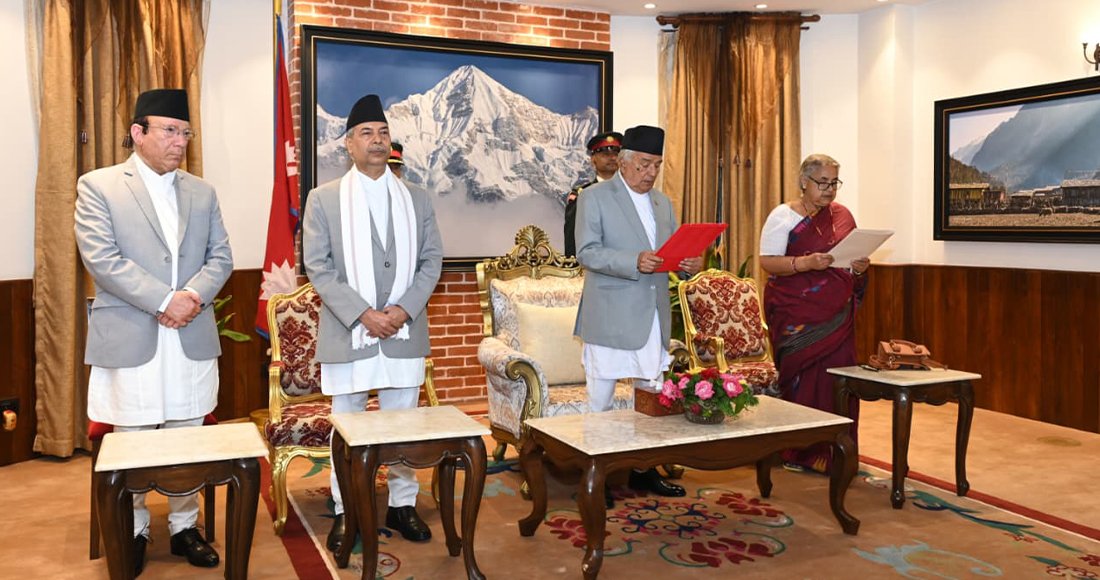
KATHMANDU: Former Chief Justice Sushila Karki has been sworn in as the Prime Minister of the interim government of Nepal. President Ram Chandra Paudel administered the oath of office and secrecy at Shital Niwas on Friday evening. She becomes Nepal’s first female prime minister and an executive head.
President Paudel appointed Karki as the Prime Minister under Article 61 of the Constitution. Since the promulgation of the new Constitution in 2015, all previous governments had been formed under Article 76. However, Karki—who assumed office with the backing of the youth-led Gen-Z movement—was appointed under Article 61, marking a significant constitutional and political shift.
Karki’s appointment as the 42nd Prime Minister follows a political agreement reached earlier in the day, after the dissolution of the House of Representatives (HoR)—a core demand of the Gen-Z protest movement and several political forces calling for systemic reform.
Following a day of intense negotiations, top leaders reached a consensus to form an interim government under Karki’s leadership. According to sources at Shital Niwas, President Paudel, who had previously insisted that Karki be appointed only after the formal dissolution of Parliament, ultimately relented amid mounting public and political pressure.
Article 61 of the Constitution of Nepal outlines provisions related to the President, but it does not mention the position, powers, or appointment of the Prime Minister. Clauses (1) and (2) of Article 61 state that the President is the Head of State and must perform their duties in accordance with the Constitution and federal laws.
Who is Sushila Karki
Sushila Karki, born 7 June 1952 in Biratnagar, is the former Chief Justice of the Supreme Court of Nepal and the only woman to have held the post. Karki became Chief Justice on 11 July 2016.
On 30 April 2017, an impeachment motion was submitted in the Parliament against Karki, by the Maoist Centre and the Nepali Congress, following the Supreme Court’s decision the previous month to overturn the government’s appointment of Jaya Bahadur Chand as chief of police in favor of Navaraj Silwal.
However, the impeachment motion was later withdrawn after public pressure and an interim order by the Supreme Court ordering the Parliament not to proceed with the motion.
Karki attended Tribhuvan University, earning a Bachelor of Arts from the Mahendra Morang College in 1972. She then studied political science in India and in 1975 received a Master’s in political science from Banaras Hindu University. She returned to Tribuhuvan University to study law, graduating in 1978.
By 1985, Karki was working as an assistant teacher at Mahendra Multiple Campus, Dharan. She participated in the 1990 People’s Movement to overthrow the Panchayat regime. She was imprisoned in Biratnagar Jail during this time; she later wrote the novel ‘Kara’ inspired by her experiences.
She became a senior Advocate at the Nepal Bar Association in 2008 and was appointed an Ad-Hoc Justice at the Supreme Court in January 2009. Her position was made permanent the following year.
After the retirement of Chief Justice Kalyan Shrestha in April 2016, Karki was recommended for the role by the Constitutional Council. She served as Ad-Hoc until her a formal parliamentary hearing the following July confirmed her appointment.
She was the first woman to act as Chief Justice and was known at the time of her appointment for being strict and against corruption. During her tenure, she faced opposition for those attributes and was accused by the government of working against them after the Supreme Court overturned the appointment of Jaya Bahadur Chand as the Police Chief of Nepal.
Impeachment proceedings were started against her in Parliament in April 2017 by the Nepal Congress and Maoist Center and she was automatically suspended.
The impeachment proceedings were viewed by many to be “politically motivated, intended to thwart the verdicts on some high-profile cases” and United Nations High Commissioner for Human Rights Zeid Ra’ad Hussein said that “the attempt to remove her gives rise to serious concerns about the Government’s commitment to transitional justice and the rule of law”.
Then Home Minister Bimalendra Nidhi resigned and the Rastriya Prajatantra Party, left the coilition it had formed with Nepal Congress and Maoist Center over the incident.
In May, the Cholendra Shumsher Rana of the Supreme Court issued a stay against the proceedings and, due to public pressure, the Nepal government withdrew. Karki resigned on 6 June 2017 after reaching the age limit of 65.
Karki, the first female Chief Justice of the Supreme Court of Nepal, was previously recommended for the post by the Constitutional Council during the tenure of former Prime Minister Khadga Prasad Oli. She is widely known for her strict stance against corruption in the judiciary and later became a prominent civic activist after stepping down from the bench.
Throughout her judicial career, Karki presided over several high-profile cases, including convicting former Minister Jayaprakash Gupta in a corruption case. She is fluent in Nepali, English, and Hindi, and has visited countries including the U.S., U.K., Sri Lanka, Japan, China, India, Tanzania, and the Netherlands. – Khabar HUB